Dumbarton Castle Scaling & Deveg
The Project
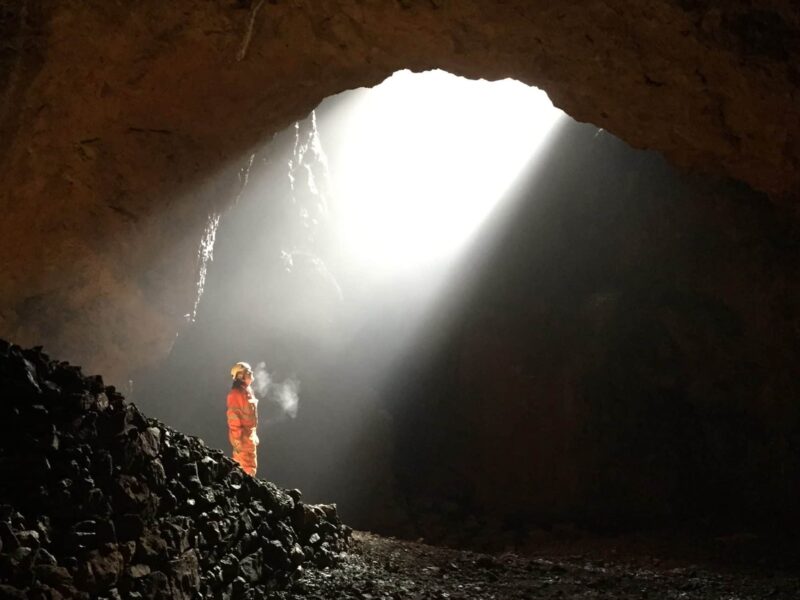
Dumbarton Castle is an iconic historic monument located on the rock formed from the plug of a volcano which existed 330 million years ago. With a human history dating back to at least the Iron Age, the site is a Scheduled Monument, and the Castle Rock is designated a Site of Special Scientific Interest (SSSI) for its geology.
The package of work Bell Access was engaged to undertake was divided into two phases. Phase 1 comprised of the scaling of rock slopes, trimming of reinforcement bars and removal of paint from the rock face. Phase 2 comprised further scaling and de-veg, and the removal of 11 mature trees in order to improve public access. The purpose of the light scaling works was to remove unstable material from the slope to reduce the potential for rockfall to impact the public paths and roads below.
The road below the rock slope in one of the areas forms the main access route to the Castle and adjacent public park and is regularly used by members of the public, including dog walkers and Castle visitors. Immediately opposite, on the far side of Castle Road, is the Rock Bowling Club, which hosts regular activities including toddler groups, line dancing, and yoga classes. Carrying out scaling work while the bowling club remained open presented the primary challenge in managing public safety and access.
Our Method
Traffic management measures, including road closures, were implemented to facilitate safe access to the construction site. Protective measures were established in the form of signed Heras fencing panels with ballast weights to segregate the pedestrian footpath from the working area, thereby maintaining safe access to the bowling club. In addition, operations were stood down either side of bowling club scheduled events in order to maximise public safety.
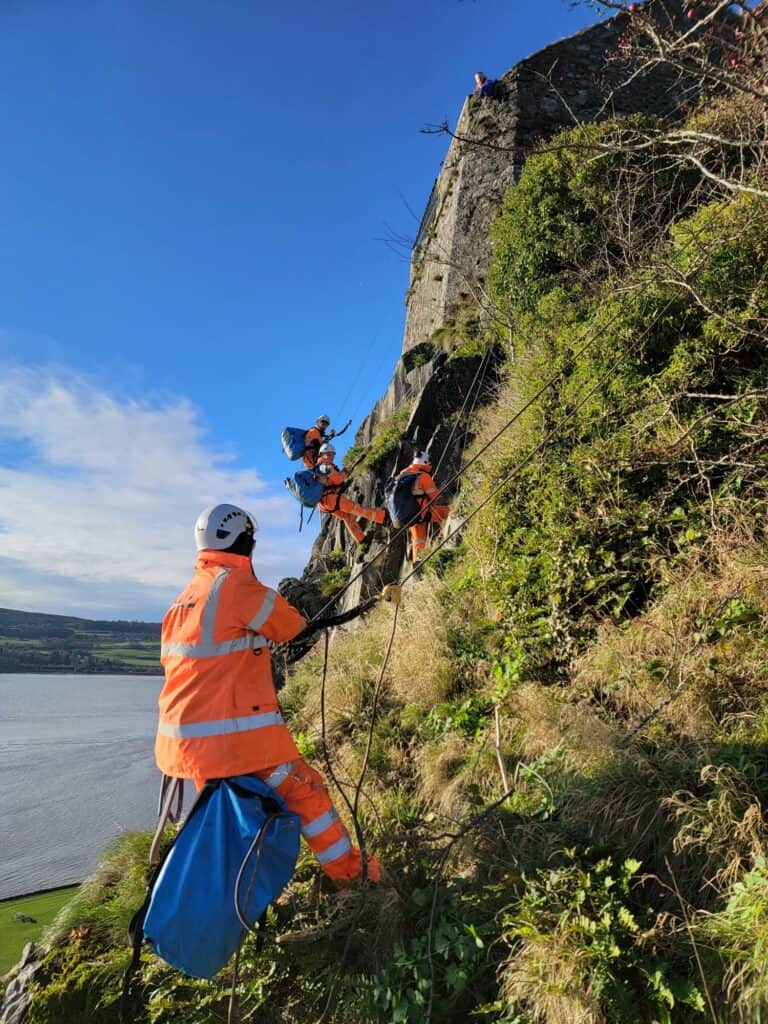
To carry out the scaling and de-vegetation works, the team used rope access techniques, with ropes rigged from dead-weight anchor boxes. During descent, 2 meters was maintained between personnel, with technicians descending at the same pace to minimise the risk of rock fall from above.
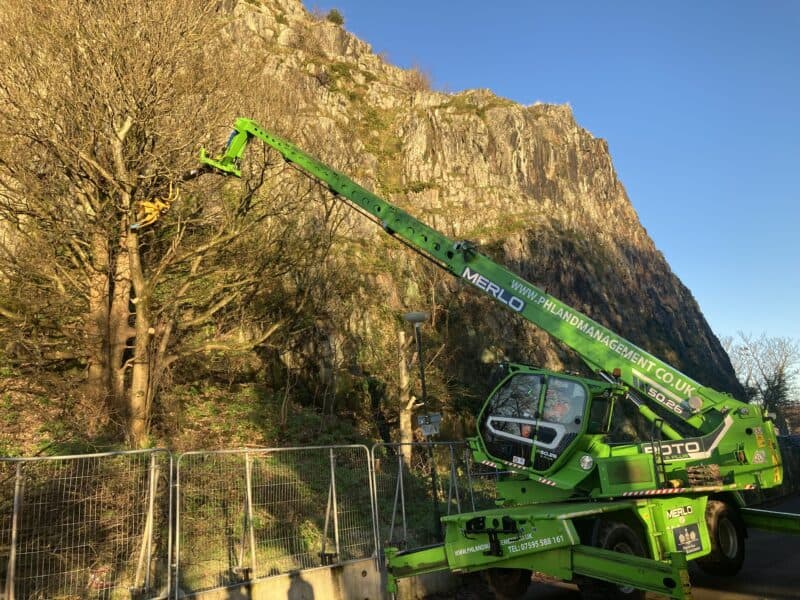
For the removal of the 11 mature trees, a Merlo roto-telehandler fitted with a grapple saw was used. This impressive piece of equipment is capable of cutting trees up to 50 cm in diameter, with a reach of 25 meters and a maximum lifting capacity of 4 tons. The use of this machinery significantly reduced the time required to process the trees and eliminated the need for arb technicians to climb and dismantle them manually, improving both efficiency and site safety.
Work Undertaken
- Light scale, inspection and de-veg of rock slope (61m in height over a length of 125m)
- Ground level vegetation clearance
- Removal of 11 mature trees
- Merlo Roto, grapple saw and operator provided by Preston Hall for tree removal
- A W Jenkinson provided chipping and green waste removal
- Tree stumps eco-plugged to prevent re-growth
The Outcome
The application of a roto-telehandler fitted with a grapple saw in this environment demonstrated an innovative approach to complex tree removal. Its combination of reach, lifting capacity, and cutting capability allowed works to be completed faster, safer, and with greater control than traditional methods, delivering measurable benefits across cost, safety, and project timescale.
Representatives from Historic Environment Scotland visited the site at various points throughout the project and were very impressed with the efficiency and professionalism delivered by the team. They commented that the capability of the Merlo roto-telehandler to safely and effectively remove the mature trees in a controlled manner demonstrated both innovative use of plant and excellent project execution.
Project Details
Location: Dumbarton, Scotland
Designer: Fairhurst
Client: Historic Environment Scotland
Duration: 4 weeks
Value: £95,000